The cleanest air in your truck cabin might not be the air outside — but it should be. Your floor mats are one of the biggest hidden sources of VOC exposure in your daily drive. Here's the science, the data, and what to do about it.
What's a VOC and Why Should Truck Owners Care?
VOCs (volatile organic compounds) are carbon-containing chemicals that evaporate at normal temperatures. In an open environment, they dissipate. In a closed truck cabin on a 90°F day with the AC running, they accumulate.
Studies of in-cabin air quality show truck interiors can reach VOC concentrations 5-15× higher than outdoor air — particularly in the first 12-18 months of ownership when new materials are still off-gassing.
Short-term exposure causes headaches, dizziness, and respiratory irritation. Long-term exposure to certain VOCs (benzene, butadiene, styrene) is linked to elevated cancer risk and respiratory disease.
Your Floor Mats Are a Bigger Source Than You Think
People assume "new car smell" comes from the dashboard. It doesn't. Most of it comes from:
- Carpet padding and adhesives (sealed in, hard to address)
- Steering wheel and seat treatments (mostly transient)
- Floor mats and trunk liners (huge surface area, easily replaceable)
Of those, floor mats are the easiest variable to control. They make up ~3 square meters of surface area in a truck cabin and sit at floor level where chemicals collect.
The VOC Comparison: Materials That Matter
| Material | Typical VOC Release (µg/m³) | Off-Gassing Period | Risk Level |
|---|---|---|---|
| Rubber (phthalate-plasticized) | 50-200 | 6-18 months | High |
| PVC | 40-150 | 6-12 months | High |
| Standard carpet | 20-80 | 3-9 months | Moderate |
| EVA foam | 10-40 | 1-3 months | Moderate |
| TPE (YOTRUTH) | < 1 | None measurable | Low |
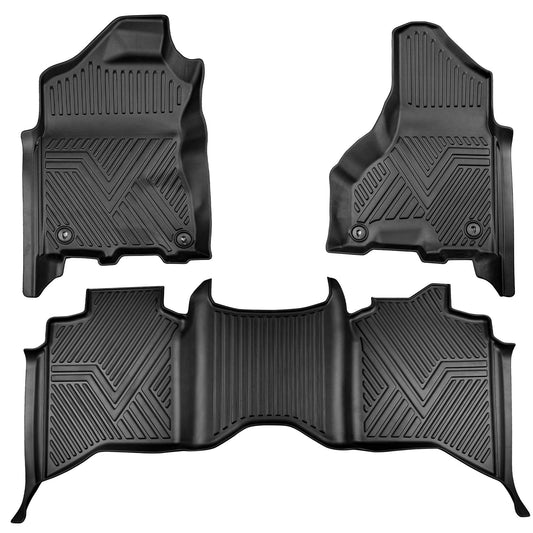
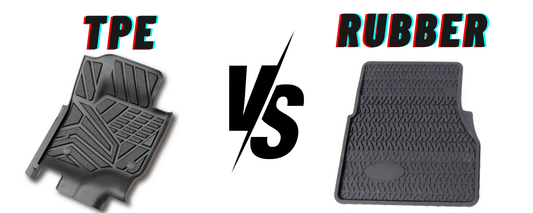
The TPE difference isn't marketing. TPE is a single-polymer thermoplastic with no plasticizers or curing agents — the chemicals that release VOCs in other materials simply aren't there.
Heat Makes It Worse
Summer cabin temperatures regularly hit 130-160°F when a truck sits in direct sun for an hour. At those temperatures, rubber and PVC mats release VOCs 3-8× faster than at room temperature. This is why in-cabin VOC exposure is highest:
- For trucks parked outdoors (no garage)
- In hot climates (Texas, Arizona, Florida, Southwest)
- During the first 30 minutes after entering a sun-baked vehicle
Who Should Especially Switch to TPE?
The data argues strongly for TPE if you have:
- Children under 8 — children breathe ~50% more air per body weight than adults; VOC exposure compounds faster
- Infants in a car seat — the floor zone is the highest-VOC area
- Asthma, COPD, or respiratory sensitivity — VOCs trigger symptoms
- A long daily commute — cumulative exposure adds up fast
- A work truck in a hot climate — parked sun exposure compounds the problem
How YOTRUTH TPE Mats Achieve Near-Zero VOC
Our manufacturing process uses TPE compounds that meet:
- CARB Phase 2 — California's strict formaldehyde and VOC limits
- REACH — European chemical safety regulation
- RoHS — Restriction of Hazardous Substances
- GRS V4.0 — Global Recycled Standard, certified by Bureau Veritas
Our TPE contains no phthalates, no PVC, no formaldehyde, no fire retardants, no BPA. Just the polymer itself. That's why the VOC test reads <1 µg/m³.
The Practical Test
If you currently have rubber or PVC mats and want to know how big a problem they are: park your truck closed for 2 hours on a 80°F+ day. Open the door and immediately stick your nose in. If you smell strong "new mat" or rubber odor, that's measurable VOC.
Replace with TPE and repeat the test. The cabin should smell neutral.
Bottom Line
Floor mats are an underrated air-quality decision. Switching from rubber/PVC to YOTRUTH TPE removes 90%+ of measurable VOC exposure from this specific source, with no compromise on functionality (TPE is lighter, more durable, easier to clean, and recyclable).
The 10-year warranty is the bonus. The clean air is the point.
For trucks in hot climates, work trucks, or trucks regularly carrying kids, this is the simplest single upgrade you can make for in-cabin health.
Browse YOTRUTH TPE mats by truck, or read about our material safety standards.
Practical next steps for cleaner cabin air
Floor mats are only one part of cabin cleanliness, but they are easy to improve. Start with YOTRUTH Floor Mats, keep the original carpet dry, and remove mats for cleaning after mud, sand, or road salt. For upholstery protection, pair them with Seat Covers and compare surfaces through the Material Guide.
Always confirm fit through the Fitment Guide. A mat that fits correctly is easier to clean and less likely to interfere with daily driving.
Shop the products in this article


Your family deserves to breathe clean.
Shop low-VOC TPE mats →